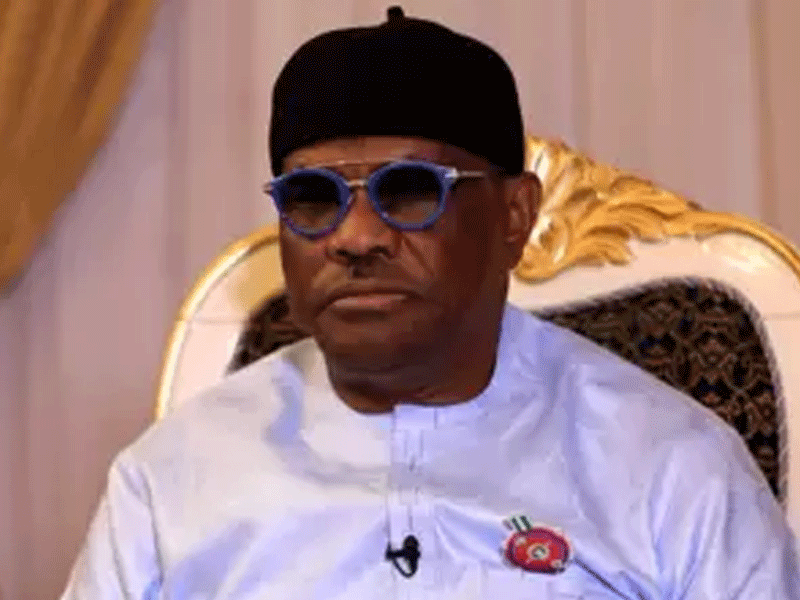
Minister of the Federal Capital Territory, Nyesom Wike, has clarified that the political coalition he is building across party lines is primarily focused on securing the re election of President Bola Ahmed Tinubu in 2027 and should not be interpreted as a campaign to strengthen the All Progressives Congress as a party.
Wike’s position comes amid growing disagreements between supporters of his Rainbow Coalition and sections of the APC, particularly over the coalition’s decision to work with politicians from different political parties while maintaining support for Tinubu’s presidential ambition.
The former Rivers State governor has consistently argued that politicians do not necessarily have to belong to the APC before supporting Tinubu. His approach has allowed individuals and political groups from opposition parties to participate in the emerging coalition while retaining their membership of their respective parties...READ THE FULL ARTICLE HERE .
The arrangement has, however, generated concerns within the APC because some members of the coalition could support Tinubu for president while backing candidates from other parties in governorship and legislative elections.
APC governors recently drew a firm line against political arrangements they believe could weaken the ruling party or undermine its candidates in the 2027 elections. The governors said they would not support alliances capable of creating divided loyalty or adversely affecting APC candidates at any level.
The development has increased political tension around Wike’s activities, particularly because the minister remains a member of the Peoples Democratic Party while serving in the APC led Federal Government.
Wike has nevertheless maintained that his political activities are aimed at preventing opposition figures from defeating Tinubu in the presidential election. He has argued that the coalition provides a platform for politicians who support the President to work together without necessarily abandoning their existing political affiliations.
Supporters of the arrangement have described it as an attempt to broaden Tinubu’s political support base ahead of 2027. Former Deputy Speaker of the House of Representatives, Chibudom Nwuche, recently described the coalition as a political strategy capable of creating an avenue for opposition politicians and groups to support Tinubu without leaving their parties.
The disagreement has become particularly noticeable in states where coalition members are supporting candidates who may be contesting against APC candidates. This has raised concerns that the arrangement could produce a situation in which voters support Tinubu at the presidential level but vote for candidates from other parties in legislative or governorship contests.
Wike has rejected the suggestion that such political activity amounts to working against Tinubu. Instead, he has presented the coalition as a broader movement designed to bring together politicians who share the objective of returning the President to office.
The minister has also clashed publicly with some APC governors over the issue. He has specifically criticised Imo State Governor Hope Uzodimma and Kwara State Governor AbdulRahman AbdulRazaq, accusing them of opposing his political activities.
The APC governors, however, insist that their loyalty must extend beyond the presidential contest to candidates officially sponsored by the party. Their latest position means that the disagreement over the Rainbow Coalition could become a significant issue within the ruling party as the 2027 election approaches.
The political development highlights the increasingly complicated alliances taking shape ahead of the 2027 general elections. Politicians who previously belonged to opposing camps are now forming new relationships based on shared interests, while established parties are attempting to protect their structures and candidates.
For Wike, the central argument remains that supporting Tinubu does not automatically require every politician to abandon their existing party. For APC governors, however, the priority is protecting the party’s candidates at every level of the election.
As political activities intensify, the disagreement over whether support for Tinubu should automatically translate into support for APC candidates is likely to remain one of the major issues shaping the emerging political alliances ahead of the 2027 elections.