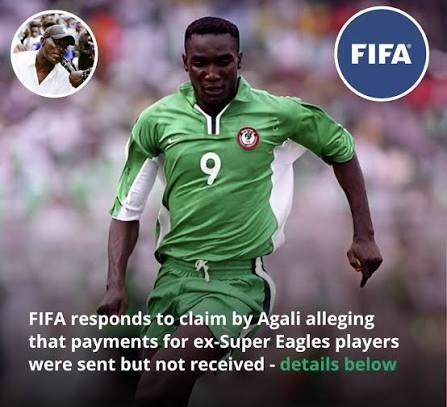
World football governing body FIFA has finally responded to the growing controversy surrounding alleged unpaid funds meant for former Super Eagles players, firmly dismissing claims made by ex-international Victor Agali and adding a new layer to an already heated debate about player welfare in Nigerian football.
The issue gained traction after Agali publicly alleged that funds sent from FIFA to Nigeria for the benefit of retired players were not reaching their intended recipients. Speaking during a podcast appearance, the former striker expressed frustration over what he described as a lack of support for ex-internationals, insisting that despite knowledge of incoming funds, he had never personally benefited from any such arrangement. ..READ THE FULL ARTICLE HERE .
However, FIFA has now moved to shut down the narrative, stating clearly that it is not aware of any specific pension or direct financial scheme targeted at former Nigerian players. In its official response, the global body described the allegation as unfounded, emphasizing that while it runs several support initiatives, none operates as a direct pension pipeline to retired national team players in Nigeria.
Instead, FIFA clarified that its existing financial support structures are broader in scope and not country-specific pension systems. Among these is the FIFA Fund for Football Players, a program designed to assist professionals who are owed salaries due to club insolvency, rather than to provide retirement benefits. Additionally, its COVID-19 relief initiative, which distributed billions globally to stabilize football during the pandemic, also benefited multiple member associations including Nigeria, but was never intended as a pension scheme.
Agali’s claims, while dismissed by FIFA, have reignited long-standing concerns about the treatment of retired players in Nigeria. Many former Super Eagles stars have, over the years, voiced dissatisfaction over inadequate welfare, lack of structured pension systems, and insufficient recognition for their contributions to the national team. His comments have once again brought those issues into sharp focus, prompting renewed calls for reforms within the Nigerian football system.
The controversy has also exposed a disconnect between perception and reality regarding how football funding works at the international level. While FIFA provides financial assistance through various programs, the responsibility for managing player welfare, including pensions or post-career support, largely falls on national federations and domestic structures rather than the global body itself.
As the conversation continues to unfold, attention is increasingly shifting toward the Nigeria Football Federation and relevant government authorities, with stakeholders urging clearer policies and more transparent systems to support former players. The federal government has previously acknowledged these concerns, pledging to improve welfare frameworks for national team players, though many argue that tangible progress remains limited.
For now, FIFA’s response may have clarified its position, but it has not silenced the broader issue. Instead, it has amplified an uncomfortable truth within Nigerian football: while players give their prime years to the national cause, the question of how they are supported after retirement remains unresolved, and increasingly impossible to ignore.