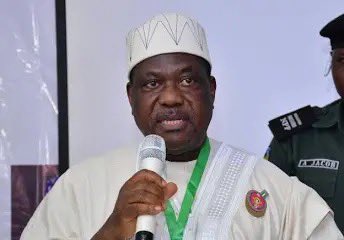
The Secretary to the Government of the Federation, George Akume, has stated that former Vice President Atiku Abubakar was among the political leaders who endorsed the adoption of rotational presidency in Nigeria following the annulment of the June 12, 1993 presidential election, a revelation that has added fresh momentum to ongoing political discussions ahead of the 2027 general elections.
Akume made the disclosure during a World Press Conference in Abuja held as part of activities commemorating Nigeria’s 27th Democracy Day anniversary. According to him, the political crisis triggered by the annulment of the election won by the late Moshood Kashimawo Olawale Abiola forced political leaders to seek solutions capable of preserving national unity and strengthening the country’s democratic foundations.
The SGF explained that key figures within the Peoples Democratic Party met in Kaduna under the leadership of the late Solomon Lar and Adamu Ciroma to deliberate on Nigeria’s political future. One of the major issues discussed at the gathering was the need for a rotational presidency arrangement that would allow power to alternate between the North and the South in order to promote inclusion and national balance. According to Akume, Atiku participated in those discussions and was part of the leaders who eventually agreed to the power-sharing arrangement. ..READ THE FULL ARTICLE HERE .
Akume noted that the decision was not reached without intense debate, describing it as a difficult but necessary compromise. He said the June 12 annulment had complicated the nation’s political landscape, making it imperative for political actors to adopt measures that would reassure different regions of fairness and representation within the democratic process. The rotational presidency model, he added, emerged as one of the key outcomes of those consultations.
The comments come at a time when debates over zoning and power rotation have once again taken centre stage in Nigerian politics. With preparations gradually gathering pace for the 2027 presidential election, discussions about which region should produce the next president have continued to dominate political conversations across the country. Atiku, who is expected to contest the presidency once again, has faced criticism from some political opponents who argue that power should remain in the South until President Bola Ahmed Tinubu completes a potential second term in office.
Reflecting on the significance of June 12, Akume described the annulment of the 1993 election as one of the most painful moments in Nigeria’s democratic history. He stressed that the election clearly reflected the will of the people and that its cancellation served as a major setback to the nation’s democratic aspirations. According to him, one of the most important lessons from the episode is that the voice of the electorate must always remain supreme in any democratic system.
The SGF also expressed confidence in Nigeria’s democratic institutions, particularly the electoral system, stating that the country has learned valuable lessons from the events of 1993. He maintained that the nation would never again tolerate a situation where a freely conducted election is annulled, emphasizing that electoral victories and defeats must be accepted as part of the democratic process.
As Nigeria prepares to mark another Democracy Day, Akume urged political actors across party lines to embrace democratic values, respect the wishes of voters, and continue working toward a more inclusive and stable political system. His remarks have once again reignited national conversations about zoning, power rotation, and the future direction of Nigeria’s democracy as the race toward 2027 gradually begins to take shape.