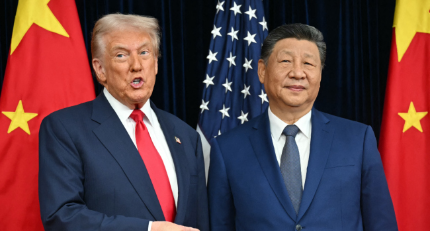
China has officially confirmed that United States President Donald Trump will visit Beijing this week for a crucial summit with Chinese President Xi Jinping, in what is already being described as one of the most closely watched diplomatic meetings of the year.
According to Chinese authorities, Trump’s state visit is scheduled to take place from May 13 to May 15, marking the first visit by a sitting American president to China in nearly a decade. The announcement comes after weeks of speculation and reports suggesting that the trip had faced delays due to rising geopolitical tensions linked to the ongoing Iran crisis and worsening global security concerns.
The meeting between both leaders is expected to focus heavily on trade relations, artificial intelligence, Taiwan, rare earth minerals, military tensions in Asia and the escalating conflict involving Iran. Analysts believe the summit could shape the direction of US-China relations for years to come, especially at a time when both countries are competing aggressively for global economic and strategic dominance. ..READ THE FULL ARTICLE HERE .
Reports indicate that Trump is expected to spend two days in Beijing engaging in high-level talks with Xi Jinping, alongside closed-door negotiations involving top government officials and business leaders from both countries. The White House is also reportedly planning to bring a select delegation of major American CEOs to the summit, including executives from companies such as Nvidia, Apple, Boeing, Qualcomm and Citigroup.
The summit is coming at a delicate moment for both nations. While Washington continues to accuse Beijing of unfair trade practices, technology restrictions and aggressive military posturing around Taiwan, China has repeatedly criticized the United States for interfering in its internal affairs and attempting to weaken its growing global influence.
One of the major issues expected to dominate discussions is Taiwan. Chinese authorities remain deeply sensitive about the island, which Beijing considers part of its territory despite Taiwan operating as a self-governing democracy. Ahead of the summit, Taiwan’s Foreign Minister Lin Chia-lung expressed hope that no “surprises” would emerge from the Trump-Xi talks regarding Taiwan’s status, while emphasizing confidence in the relationship between Taipei and Washington.
The Iran conflict is also expected to feature prominently during the meeting. Reports suggest the Trump administration wants China to use its influence over Tehran to help reduce tensions in the Middle East following months of instability that have affected global oil prices and international trade routes. China, which maintains strong economic ties with Iran, has reportedly been urging diplomatic negotiations instead of military escalation.
Trade negotiations are another critical aspect of the visit. Both countries are currently operating under a fragile trade truce following years of tariff battles that disrupted global markets and supply chains. American officials are reportedly seeking expanded Chinese purchases of US agricultural products, aircraft and energy exports, while Beijing is expected to push for relief from American restrictions on semiconductor technology and advanced electronics.
Observers believe the summit could also influence the future of artificial intelligence regulation and military communication between both superpowers. Reports suggest both sides are considering the creation of new communication channels aimed at reducing the risk of conflict arising from cyber threats, AI competition and military misunderstandings in the Asia-Pacific region.
Political analysts say the meeting carries enormous significance for Trump, who is seeking to project strength on the global stage amid criticism over several international crises. For Xi Jinping, the summit presents an opportunity to showcase China as a stable and influential global power capable of negotiating with Washington from a position of confidence.
The visit will also be closely monitored by America’s allies across Asia, including Japan, South Korea and the Philippines, as concerns continue to grow over China’s expanding military activities in the region. Many governments are watching carefully to see whether the summit produces agreements that could ease tensions or further reshape the balance of power in Asia.
Although expectations for a dramatic breakthrough remain low, experts say even a modest reduction in tensions between Washington and Beijing could have significant implications for global trade, diplomacy and international security. With both leaders facing mounting pressure at home and abroad, the Beijing summit is now being viewed as one of the defining geopolitical moments of 2026.