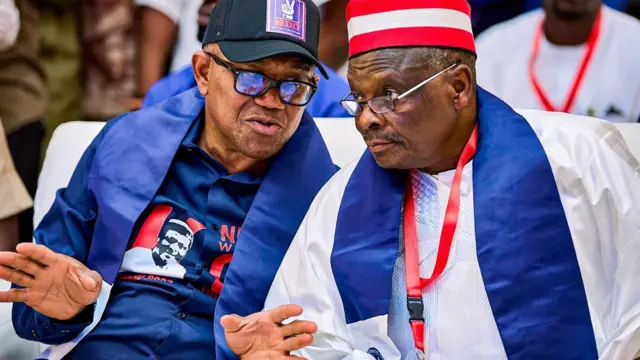
The proposed political alliance between former Labour Party presidential candidate, Peter Obi, and former Kano State governor, Rabiu Musa Kwankwaso, has encountered fresh resistance in Northern Nigeria as several influential groups and stakeholders openly rejected the emerging coalition ahead of the 2027 general elections. The development is being viewed as a significant challenge to opposition efforts aimed at building a formidable political force capable of contesting power in the next presidential election.
According to reports, some northern organisations have gone as far as describing the proposed Obi-Kwankwaso partnership as “haram,” a term commonly used to refer to something considered unacceptable or forbidden. Campaign materials opposing the alliance have reportedly surfaced in parts of the region, reflecting growing resistance among certain political and youth groups who believe the coalition does not align with northern political interests and aspirations.
Among those expressing reservations is the Arewa Consultative Forum, whose National Publicity Secretary, Prof. Tukur Muhammad-Baba, questioned the political strength of the platform expected to host the alliance. He argued that many voters across the North remain unfamiliar with the party and suggested that its grassroots structures are not yet strong enough to generate widespread support. He also raised concerns about Kwankwaso’s political influence beyond Kano State, noting that his electoral strength across the wider northern region remains uncertain. ..READ THE FULL ARTICLE HERE .
The opposition to the alliance became even more visible in Kano State following reports that campaign posters bearing the images of Obi and Kwankwaso were torn down by youths in parts of the state. The incident underscored the divisions surrounding the proposed partnership and highlighted the difficulty of securing unanimous support within the region.
The Northern Youths Assembly also criticised the reported alliance, describing it as a departure from the ideals traditionally associated with the Kwankwasiyya movement. In a statement issued by the group’s leadership, members argued that Kwankwaso’s decision to align with Obi raised serious concerns about his commitment to northern political values and interests. The group maintained that the alliance contradicted the principles upon which the movement gained popularity across Northern Nigeria.
Some northern youth leaders further claimed that Obi faces a perception challenge in the region. According to them, many northern voters remain sceptical of his political positioning, making it difficult for the proposed alliance to gain the level of acceptance required to compete effectively against established political forces. These critics insist that name recognition alone may not translate into electoral success in a region that remains crucial to determining the outcome of presidential elections.
Despite the growing opposition, supporters of the coalition have dismissed suggestions that the alliance lacks support in the North. Leaders associated with the political movement behind the partnership insist that membership and grassroots structures are expanding across several northern states. They argue that increasing dissatisfaction with traditional political parties, particularly among young voters, is creating opportunities for alternative political platforms to gain traction.
The debate surrounding the Obi-Kwankwaso alliance reflects the broader political realignments already taking shape ahead of the 2027 general elections. While supporters see the partnership as a potentially powerful combination capable of challenging the country’s dominant political parties, opponents believe significant hurdles remain, particularly in Northern Nigeria, where political acceptance and grassroots mobilisation will likely play a decisive role in determining the success or failure of any coalition. As political calculations intensify, the coming months are expected to reveal whether the proposed alliance can overcome regional resistance and transform itself into a credible national force.