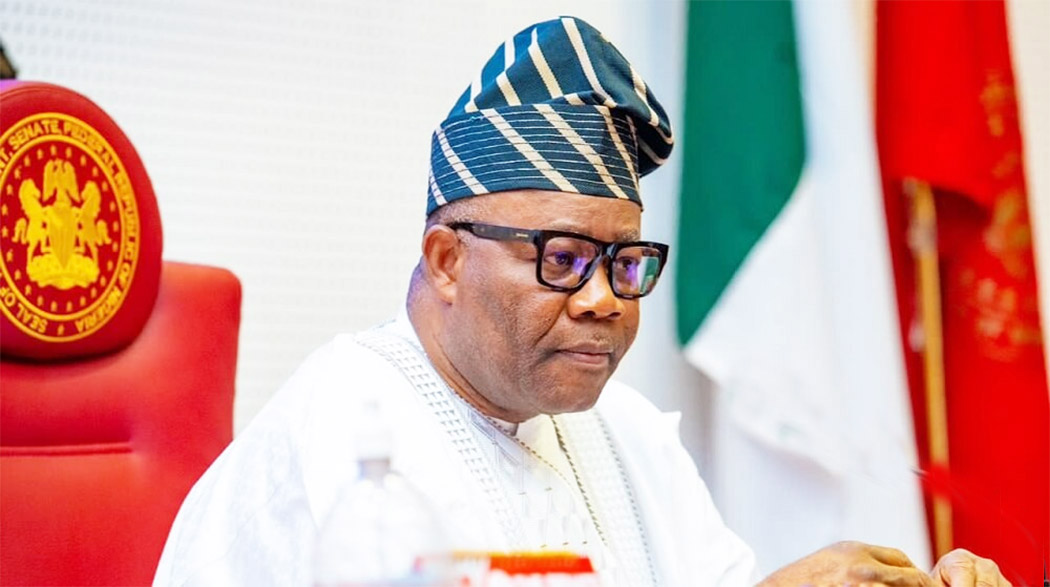
Nigeria’s political scene witnessed a dramatic moment in the National Assembly as Senate President Godswill Akpabio openly declared that the African Democratic Congress is effectively “dead,” following a fresh wave of defections that has significantly weakened the party’s presence in the legislature.
The remark was made during plenary while Akpabio presided over proceedings and formally announced the defection of several lawmakers from the ADC to other political platforms, including the Nigeria Democratic Congress and the Labour Party. His comment, though delivered in a lighthearted tone, quickly drew reactions within the chamber and across the political landscape, reflecting the seriousness of the ongoing political shifts.
Akpabio, reacting to the growing list of lawmakers leaving the party, jokingly suggested that defecting members should submit their names in bulk rather than having their exits announced one after another. He noted that the frequency of defections had become so regular that it was beginning to resemble a daily routine within the National Assembly. ..READ THE FULL ARTICLE HERE .
The development comes amid a broader realignment in Nigerian politics, as several legislators continue to switch allegiances in preparation for the 2027 general elections. Notably, key figures such as Senator Victor Umeh and Senator Enyinnaya Abaribe were among those who recently exited the ADC, citing internal crises, leadership disputes, and prolonged legal battles within the party as reasons for their departure.
In addition to movements in the Senate, the House of Representatives has also recorded significant defections, with more than a dozen lawmakers reportedly leaving the ADC for the Nigeria Democratic Congress. This mass exodus has further fueled concerns about the party’s stability and its ability to remain a strong force in Nigeria’s opposition politics.
Political observers say Akpabio’s comment, while seemingly humorous, reflects a deeper reality about the current state of the ADC, which has been grappling with internal divisions, leadership tussles, and legal uncertainties in recent months. These issues have made it increasingly difficult for the party to maintain cohesion, especially as political actors reposition themselves ahead of the next election cycle.
Reactions to the Senate President’s statement have been mixed, with some interpreting it as a blunt assessment of the party’s declining influence, while others view it as political rhetoric aimed at undermining opposition efforts. Supporters of the ADC, however, maintain that the party still has relevance and could rebound despite the current challenges.
The situation also highlights a recurring trend in Nigeria’s political system, where defections remain a common strategy for lawmakers seeking better platforms or stronger alliances. While such movements are constitutionally allowed, critics argue that frequent party switching can weaken ideological consistency and reduce public trust in the political process.
As the wave of defections continues, attention will remain on how the ADC responds to the growing crisis and whether it can rebuild its structure in time for future elections. For now, Akpabio’s controversial declaration has added fuel to an already intense political atmosphere, underscoring the rapidly shifting dynamics within Nigeria’s National Assembly.