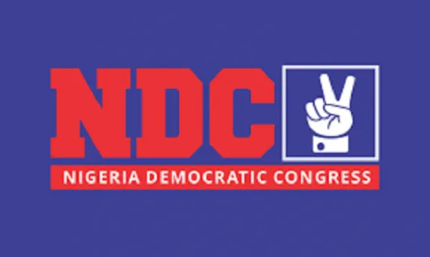
The Nigeria Democratic Congress has secured a major victory in its ongoing dispute over the party’s identity after the Independent National Electoral Commission approved its logo ahead of the 2027 general elections.
The development is significant for the relatively new political platform as it continues to position itself for a major role in Nigeria’s next general election. The approval gives the party greater clarity over the symbol under which it will operate and campaign as preparations for the election gather momentum.
The dispute over the logo had generated considerable attention because political parties rely heavily on their symbols and colours for identification, particularly during elections. The logo that appears on ballot papers provides voters with a direct means of identifying their preferred political party and candidates...READ THE FULL ARTICLE HERE .
The NDC had faced questions surrounding the use and ownership of its chosen symbol, creating uncertainty over whether the party would be able to retain the identity it had been using as it expands its political activities across the country.
With INEC now approving the logo, the party has received an important boost as it works towards strengthening its structures and increasing its visibility ahead of 2027.
The development comes at a time when Nigeria’s political landscape is already experiencing significant realignment. Several politicians and political groups are repositioning themselves in preparation for the next presidential and legislative elections, while new alliances and emerging platforms are seeking to attract supporters across different parts of the country.
For the NDC, having an officially recognised logo is particularly important because the party will need a clear electoral identity as it seeks to present itself to voters. Political parties must establish strong recognition among the electorate, and their symbols often become a major part of their campaign identity.
The approval also potentially removes one source of uncertainty that could have affected the party’s preparations. Rather than continuing to focus on a dispute over its logo, the party can now concentrate more heavily on organisation, membership mobilisation, candidate selection, grassroots structures and its broader political programme.
As the 2027 election approaches, the competition among political parties is expected to become increasingly intense. The ruling All Progressives Congress remains a major force, while opposition groups and emerging political movements are working to build alternative platforms capable of attracting Nigerians who are dissatisfied with existing political arrangements.
The NDC’s development therefore adds another dimension to the evolving political contest. Its ability to transform the latest administrative victory into a strong nationwide political organisation will depend on how effectively it builds its structures and communicates its message to voters.
The logo approval is not, by itself, an indication of electoral success. However, it provides the party with an important foundation as it prepares to participate in the 2027 elections under a clearly recognised identity.
With political activities expected to intensify in the months ahead, the NDC will now face the larger challenge of converting its growing visibility into genuine grassroots support and electoral strength.
The latest development consequently represents more than a victory in a dispute over a party symbol. It marks another step in the NDC’s preparations for the 2027 election and signals the increasingly crowded political field that Nigerian voters are likely to encounter as the country moves closer to the next general election.