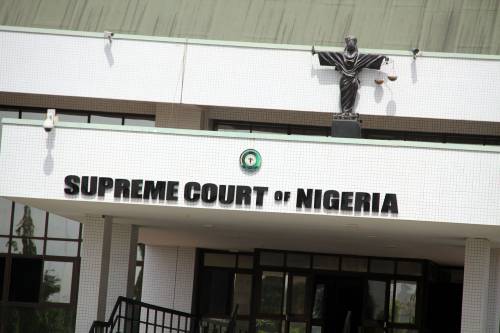
Nigeria’s political atmosphere has reached a critical point as the Supreme Court prepares to deliver a decisive judgment that could determine the future of two major opposition parties, the Peoples Democratic Party and the African Democratic Congress, ahead of the 2027 general elections.
The apex court is expected to rule on longstanding leadership disputes within both parties, cases that have lingered through multiple legal stages and now carry significant implications for the country’s political balance. The verdict, scheduled for today, is widely seen as a turning point that could either stabilise or further fragment the opposition landscape.
At the centre of the PDP’s case is a dispute over the legitimacy of its national convention held in Ibadan in November 2025. A faction within the party is seeking validation of the convention, while opposing groups argue that the process violated internal rules and existing court orders. Lower courts had earlier nullified aspects of the exercise, prompting appeals that have now reached the Supreme Court for final determination. ..READ THE FULL ARTICLE HERE .
For the ADC, the crisis revolves around a prolonged leadership tussle involving rival factions laying claim to the party’s national structure. The dispute has already triggered a series of legal battles and conflicting court rulings, with the Independent National Electoral Commission at one point withdrawing recognition of certain party leaders pending resolution of the case.
The urgency surrounding the Supreme Court’s decision is closely tied to the electoral timetable released by INEC, which sets strict deadlines for party primaries, submission of membership registers, and other pre-election requirements. Analysts warn that any delay or unfavourable outcome could jeopardise the ability of affected parties to fully participate in the 2027 elections, effectively reshaping the political field.
In anticipation of the ruling, key stakeholders within the ADC reportedly held emergency strategy meetings to assess possible outcomes and plan their next steps. Notably, the party leadership has expressed confidence in a favourable judgment, insisting that it will remain a viable platform for contesting the upcoming elections despite ongoing legal challenges.
The stakes are particularly high because both parties play crucial roles in Nigeria’s opposition politics. Any disruption to their structure or legal standing could weaken the opposition’s ability to mount a coordinated challenge in 2027, potentially altering the dynamics of political competition in the country.
Observers note that beyond internal party disputes, the case reflects deeper issues around internal democracy, judicial intervention in party affairs, and the broader struggle for control within Nigeria’s political system. The outcome is expected to influence not just party leadership but also alliances, defections, and the overall configuration of the opposition bloc.
As political actors, supporters, and analysts await the Supreme Court’s pronouncement, the atmosphere remains tense, with many recognising that the decision will go far beyond legal technicalities. It is set to shape the trajectory of Nigeria’s democratic process and determine how competitive the 2027 elections will ultimately be.