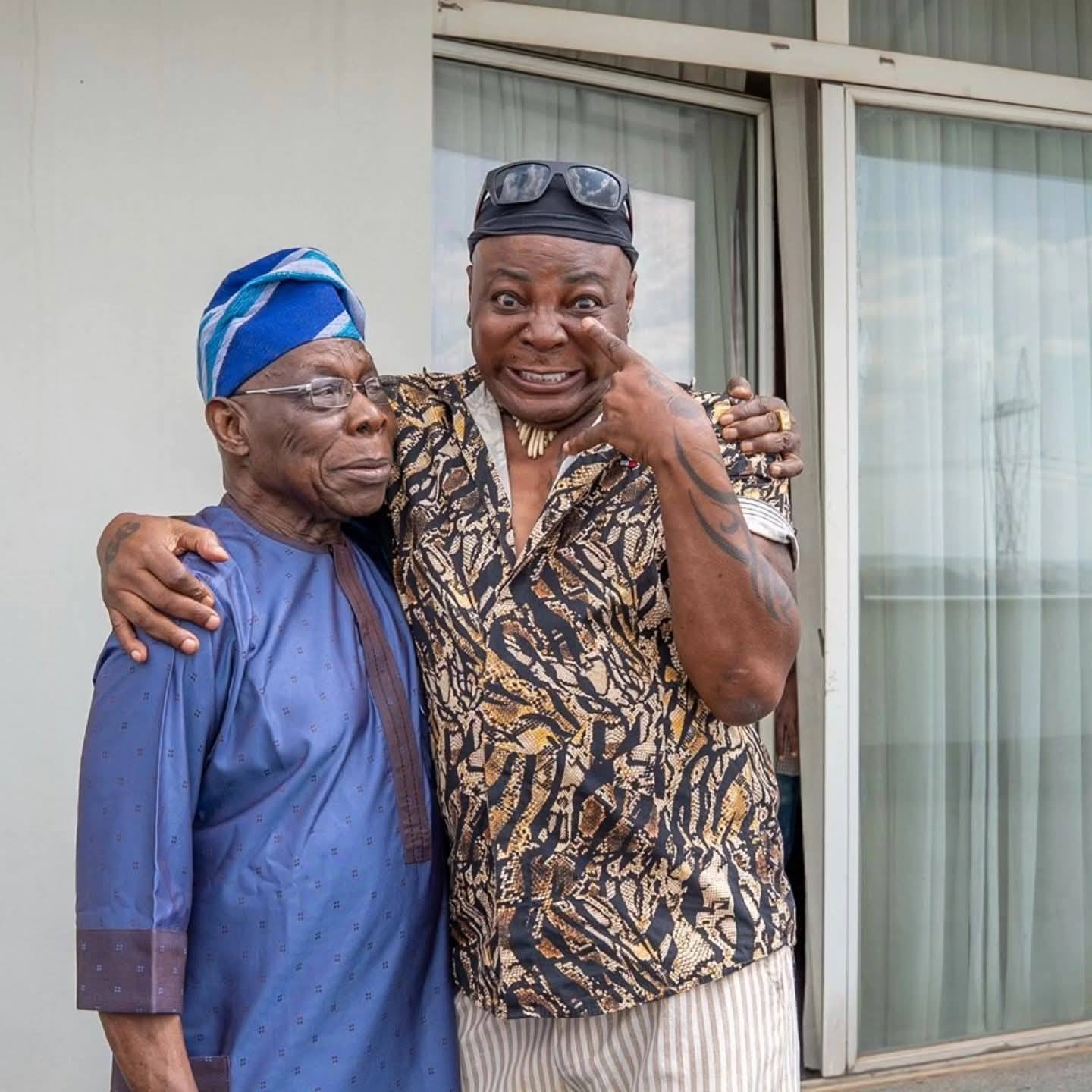
Former President Olusegun Obasanjo has stirred fresh national conversation after openly explaining why he continues to admire Nigerian entertainer and activist Charles Oputa, popularly known as Charly Boy, despite what he described as his unconventional and often controversial public lifestyle.
Speaking during a recent reflection on personalities he has encountered across different generations, Obasanjo made it clear that his admiration for Charly Boy is not based on agreement with his choices or public image, but on what he sees as authenticity, courage, and an unwillingness to conform to societal pressure when it comes to speaking his mind. He acknowledged that many Nigerians often dismiss Charly Boy because of his appearance, lifestyle, and outspoken nature, which some critics have repeatedly labeled as chaotic or “jaga jaga,” but insisted that such surface judgments often miss deeper value.
According to Obasanjo, one of the lessons he has learned over decades in leadership and public life is that people should not be judged solely by outward presentation or personal style. He noted that individuals who challenge established systems or speak uncomfortable truths are often misunderstood, especially in societies where conformity is highly valued. In his view, Charly Boy represents a category of people who may not fit into conventional expectations but still play a role in pushing society to reflect on its realities...READ THE FULL ARTICLE HERE .
The former president emphasized that while he does not necessarily endorse all of Charly Boy’s actions or expressions, he recognizes the consistency with which the entertainer has used his platform to question authority, criticize governance, and draw attention to social issues. He said that such fearlessness is rare and should not be ignored, even when it comes in a form that many people find uncomfortable or controversial.
Charly Boy, whose career spans music, television, activism, and cultural commentary, has long been one of Nigeria’s most polarizing public figures. Known for his eccentric fashion sense, outspoken opinions, and frequent criticism of political leaders, he has built a reputation as someone who deliberately defies norms. Over the years, he has also been involved in various social campaigns, including youth advocacy, civic awareness, and protests against governance failures.
Interestingly, despite their very different backgrounds and worldviews, Charly Boy and Obasanjo have at different times expressed mutual respect for each other. Their relationship has often surprised political observers, especially given Obasanjo’s long history as a military leader and two time civilian president, and Charly Boy’s identity as a cultural rebel who challenges establishment authority.
Obasanjo further suggested that Nigeria as a society needs to become more open to understanding people beyond stereotypes. He argued that the tendency to quickly label individuals based on appearance or lifestyle often prevents deeper appreciation of their contributions to public discourse. In his words, leadership and influence should be evaluated based on impact, honesty, and the ability to stimulate national reflection, rather than conformity to social expectations.
His comments have since generated widespread reactions across the country, particularly on social media, where Nigerians are divided between admiration for his openness and criticism of his choice of example. Some commentators praised Obasanjo for demonstrating intellectual openness and maturity in recognizing value in unconventional voices, while others argued that endorsing such figures could be seen as controversial given their polarizing public image.
However, analysts note that the statement reflects a broader pattern in Obasanjo’s public engagements, where he often expresses unconventional opinions and challenges public assumptions about leadership, morality, and influence. They also point out that his remarks highlight the evolving relationship between Nigeria’s political elite and cultural figures who increasingly shape public opinion through activism, entertainment, and media presence.
In the wider context, the discussion around Obasanjo’s comments also raises deeper questions about how societies define respectability, leadership, and influence. While traditional systems often prioritize formality and structure, modern public life increasingly values visibility, authenticity, and the ability to spark conversation, even if it comes through unconventional means.
For many observers, the exchange between Obasanjo and Charly Boy represents more than a personal opinion. It reflects a changing Nigeria where political authority and cultural activism intersect in complex ways, and where influence is no longer confined to official positions but also shaped by voices that challenge the status quo in unexpected forms.