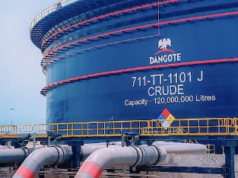
The Dangote Petroleum Refinery received the overwhelming majority of crude oil offered to Nigeria’s domestic refineries during the second quarter of 2026, accounting for about 98 per cent of the total volume allocated to local refining plants during the period.
The development highlights the dominant position of the Dangote refinery in Nigeria’s evolving domestic refining industry and comes amid continued efforts by the Federal Government to increase local refining capacity and reduce the country’s dependence on imported petroleum products.
Data from the Nigerian Upstream Petroleum Regulatory Commission showed that a total of 3.8 million barrels of crude oil were offered to domestic refineries during the second quarter of the year...READ THE FULL ARTICLE HERE .
Out of that volume, the Dangote refinery reportedly received approximately 3.7 million barrels, representing about 98 per cent of the crude offered to local refineries.
The figures provide an indication of the scale of crude supply reaching the country’s largest privately owned refinery compared with other domestic refining facilities.
The development is particularly significant because access to adequate crude supplies remains a major factor in the ability of Nigerian refineries to operate consistently.
For years, Nigeria has struggled with the challenge of refining enough crude locally to meet domestic demand despite being one of Africa’s major oil producing countries.
The situation contributed significantly to the country’s long dependence on imported petrol, diesel and other refined petroleum products.
The emergence of large scale domestic refining capacity, particularly the Dangote refinery, has changed part of that landscape by creating additional capacity to process crude oil within the country.
However, the availability of crude remains an important issue for the refinery sector.
The reported second quarter figures also come amid discussions over the implementation of policies designed to prioritise crude supply to Nigerian refineries.
Under Nigeria’s petroleum industry framework, the government has continued to pursue measures aimed at ensuring that domestic refineries have access to crude produced within the country.
The objective is to support local refining, strengthen energy security and reduce the amount of refined petroleum products Nigeria needs to import.
The Dangote refinery, located in Lagos, has the capacity to process hundreds of thousands of barrels of crude oil per day and has become a major part of Nigeria’s strategy to increase domestic refining.
Its operations have attracted significant attention because of the potential impact on fuel supply, foreign exchange demand and Nigeria’s position in the international petroleum market.
If domestic refineries can consistently obtain sufficient crude, Nigeria could potentially reduce its dependence on imported refined products and retain more value from its oil resources within the country.
However, the reported allocation figures also raise questions about the availability of crude for other local refineries.
With the Dangote refinery accounting for approximately 98 per cent of crude offered to domestic plants during the quarter, other refining facilities received only a relatively small share of the reported volume.
The situation could fuel further discussions among operators and policymakers about crude allocation, refinery capacity, production levels and the need to ensure that all functional domestic refineries can access sufficient feedstock.
Nigeria has several existing and developing refinery projects, including state owned facilities undergoing rehabilitation and privately owned plants operating at different levels of capacity.
The ability of these facilities to obtain crude will remain important as the country seeks to build a stronger domestic petroleum value chain.
Increased local refining could also have broader economic implications.
A stronger refining industry could reduce pressure on foreign exchange reserves by lowering the need to import petroleum products, while creating opportunities for employment, logistics, engineering services and other businesses connected to the oil and gas sector.
For consumers, the most important issue will ultimately be whether increased domestic refining translates into more reliable fuel supply and greater stability in petroleum product prices.
The reported crude allocation to the Dangote refinery therefore represents more than just an industry statistic. It reflects the changing structure of Nigeria’s downstream petroleum sector and the growing role of large scale private refining capacity.
As the country continues to expand domestic refining, the availability and fair allocation of crude will remain central to the success of the sector.
The latest figures show that the Dangote refinery has secured a dominant share of crude offered to local refineries, but the broader challenge for Nigeria remains ensuring that its growing refining capacity is adequately supplied and efficiently utilised.
For the government, regulators and refinery operators, the next phase will be to maintain a reliable crude supply system capable of supporting domestic refining while ensuring that Nigeria’s oil resources deliver greater value to the local economy.